Presented by Brian at the October 2025 meeting
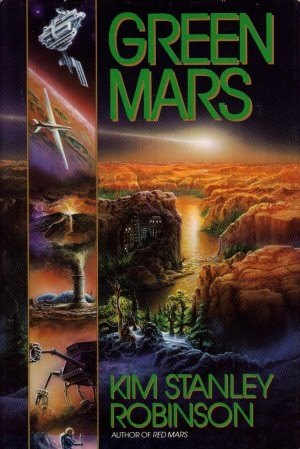
Green Mars
- Published 1993
- Fiction
- 656 pages
- Brian4
In brief
The second of a 3 part Sci-Fi trilogy about the colonization of mars.
From the publisher
In the Nebula Award winning Red Mars, Kim Stanley Robinson began his critically acclaimed epic saga of the colonization of Mars, Now the Hugo Award winning Green Mars continues the thrilling and timeless tale of humanity's struggle to survive at its farthest frontier.Nearly a generation has passed since the first pioneers landed, but the transformation of Mars to an Earthlike planet has just begun The plan is opposed by those determined to preserve the planets hostile, barren beauty. Led by rebels like Peter Clayborne, these young people are the first generation of children born on Mars. They will be joined by original settlers Maya Toitovna, Simon Frasier, and Sax Russell. Against this cosmic backdrop, passions, rivalries, and friendships explode in a story as spectacular as the planet itself.From the Paperback edition.
From Wikipedia
The Mars trilogy is a series of science fiction novels by Kim Stanley Robinson that chronicles the settlement and terraforming of the planet Mars through the personal and detailed viewpoints of a wide variety of characters spanning 187 years, from 2026 to 2212. Ultimately more utopian than dystopian, the story focuses on egalitarian, sociological, and scientific advances made on Mars, while Earth suffers from overpopulation and ecological disaster.
The three novels are Red Mars (1992), Green Mars (1993), and Blue Mars (1996). The Martians (1999) is a collection of short stories set in the same fictional universe. Red Mars won the BSFA Award in 1992 and Nebula Award for Best Novel in 1993. Green Mars won the Hugo Award for Best Novel and Locus Award for Best Science Fiction Novel in 1994. Blue Mars also won the Hugo and Locus Awards in 1997.
Icehenge (1984), Robinson's first novel about Mars, is not set in this universe but deals with similar themes and plot elements. The trilogy shares some similarities with Robinson's more recent novel 2312 (2012); for instance, the terraforming of Mars and the extreme longevity of the characters in both novels.