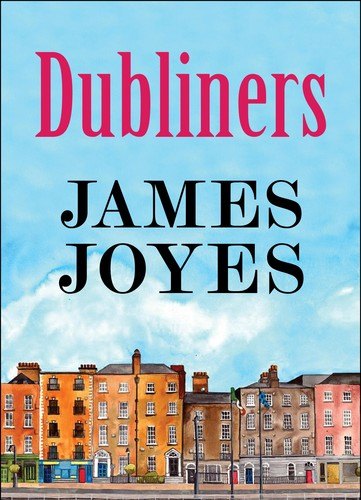
Presented by Alex at the October 2025 meeting
Dubliners
- Published 1914
- Fiction
- 240 pages
- Alex3
In brief
I was in Ireland, so had to read a classic. I am sure it was a hit back when - very real, descriptive of lives there, then.
From the publisher
James Joyce's disillusion with the publication of Dubliners in 1914 was the result of ten years battling with publishers, resisting their demands to remove swear words, real place names and much else, including two entire stories. Although only 24 when he signed his first publishing contract for the book, Joyce already knew its worth: to alter it in any way would 'retard the course of civilisation in Ireland'. Joyce's aim was to tell the truth -- to create a work of art that would reflect life in Ireland at the turn of the last century. By rejecting euphemism, he would reveal to the Irish the unromantic reality, the recognition of which would lead to the spiritual liberation of the country. Each of the fifteen stories offers a glimpse of the lives of ordinary Dubliners -- a death, an encounter, an opportunity not taken, a memory rekindled -- and collectively they paint a portrait of a nation. - Back cover.
Dubliners is a collection of vignettes of Dublin life at the end of the 19th Century written, by Joyce’s own admission, in a manner that captures some of the unhappiest moments of life. Some of the dominant themes include lost innocence, missed opportunities and an inability to escape one’s circumstances.
Joyce’s intention in writing Dubliners, in his own words, was to write a chapter of the moral history of his country, and he chose Dublin for the scene because that city seemed to him to be the centre of paralysis. He tried to present the stories under four different aspects: childhood, adolescence, maturity and public life.\
‘The Sisters’, ‘An Encounter’ and ‘Araby’ are stories from childhood. ‘Eveline’, ‘After the Race’, ‘Two Gallants’ and ‘The Boarding House’ are stories from adolescence. ‘A Little Cloud’, ‘Counterparts’, ‘Clay’ and ‘A Painful Case’ are all stories concerned with mature life. Stories from public life are ‘Ivy Day in the Committee Room’ and ‘A Mother and Grace’. ‘The Dead’ is the last story in the collection and probably Joyce’s greatest. It stands alone and, as the title would indicate, is concerned with death.
From Wikipedia
Dubliners is a collection of fifteen short stories by James Joyce, written from 1904 to 1907. First published in 1914, Dubliners presents a naturalistic depiction of Irish middle-class life in and around Dublin in the early twentieth century.
The stories were written when Irish nationalism was at its peak, and a search for a national identity and purpose was raging; at a crossroads of history and culture, Ireland was jolted by various converging ideas and influences. Joyce felt Irish nationalism, like Catholicism and British rule of Ireland, was responsible for a collective paralysis—a theme permeating much of the work. He conceived of Dubliners as a "nicely polished looking-glass" held up to the Irish and a "first step towards [their] spiritual liberation".
Joyce's concept of epiphany is exemplified in the moment a character experiences self-understanding or illumination. The first three stories in the collection are narrated by young boy protagonists; the subsequent stories are written in the third person and deal with the lives and concerns of progressively older people, in line with Joyce's division of the collection into "childhood, adolescence, maturity, and public life". Many of the characters in Dubliners later appeared in minor roles in Joyce's novel Ulysses.