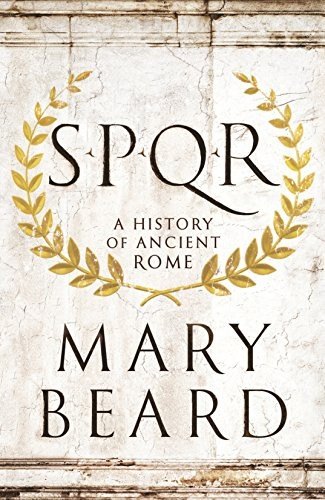
Presented by Matt at the July 2026 meeting
SPQR: A History of Ancient Rome
- Published 2016
- Non-fiction
- 644 pages
- Matt3
In brief
The Roman Republic and then Empire in all its pomp, cruelty, and (sometime) wisdom.
From the publisher
"Ancient Rome matters. Its history of empire, conquest, cruelty and excess is something against which we still judge ourselves. Its myths and stories - from Romulus and Remus to the Rape of Lucretia - still strike a chord with us. And its debates about citizenship, security and the rights of the individual still influence our own debates on civil liberty today. SPQR is a new look at Roman history from one of the world's foremost classicists. It explores not only how Rome grew from an insignificant village in central Italy to a power that controlled territory from Spain to Syria, but also how the Romans thought about themselves and their achievements, and why they are still important to us. Covering 1,000 years of history, and casting fresh light on the basics of Roman culture from slavery to running water, as well as exploring democracy, migration, religious controversy, social mobility and exploitation in the larger context of the empire, this is a definitive history of ancient Rome. SPQR is the Romans' own abbreviation for their state: Senatus Populusque Romanus, 'the Senate and People of Rome'"--Jacket.
From Wikipedia
SPQR: A History of Ancient Rome is a 2015 book by English classicist Mary Beard that was published in the United Kingdom by Profile Books and elsewhere by Liveright & Company.
SPQR appeared on the New York Times hardcover, non-fiction bestseller list in December 2015. It was a finalist for the 2015 National Book Critics Circle Award (Nonfiction).
SPQR or S.P.Q.R., an initialism for Senatus Populusque Romanus (Classical Latin: [sɛˈnaːtʊs pɔpʊˈɫʊskʷɛ roːˈmaːnʊs]; transl. "The Senate and People of Rome"), is an emblematic phrase referring to the government of the Roman Republic. It appears on documents made public by an inscription in stone or metal, in dedications of monuments and public works, and on some Roman currency.