Presented by Matt at the April 2023 meeting
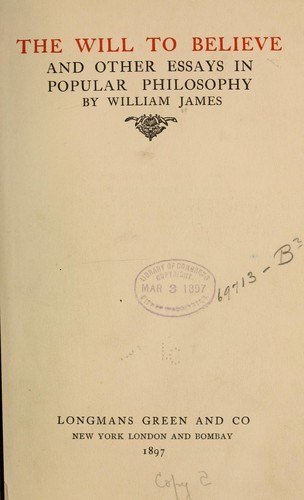
The Will to Believe
- Published 1897
- Non-fiction
- 332 pages
- Matt2
In brief
Philosophical essays defending the right to adopt a believing attitude in religious matters.
From the publisher
This volume contains the complete texts of two books by America's most important psychologust and philospher. Easy to understand, yet, brilliant and penetrating, the books were written specifically for laymen and they are still stimulating reading for readers concerned with important questions of belief in an age of science. Human Immorality: Two supposed Objections to the Doctrine, reprinted here from the corrected second edition, examines the questions of survival after death, and provides an unusual philosophical rebuttal to the theory that thought and personality necesscarily die with the brain.
From Wikipedia
"The Will to Believe" is a lecture by William James, first published in 1896, which defends, in certain cases, the adoption of a belief without sufficient evidence of its truth. In particular, James is concerned in this lecture about defending the rationality of religious faith even lacking sufficient evidence of religious truth. James states in his introduction: "I have brought with me tonight ... an essay in justification of faith, a defense of our right to adopt a believing attitude in religious matters, in spite of the fact that our merely logical intellect may not have been coerced. 'The Will to Believe,' accordingly, is the title of my paper."
James' central argument in "The Will to Believe" hinges on the idea that access to the evidence for whether certain beliefs are true depends crucially upon first adopting those beliefs without evidence. As an example, James argues that it can be rational to have unsupported faith in one's own ability to accomplish tasks that require confidence. Importantly, James points out that this is the case even for pursuing scientific inquiry. James then argues that like belief in one's own ability to accomplish a difficult task, religious faith can also be rational even if one at the time lacks evidence for the truth of one's religious belief.